I Spent Decades Building Document Management for Engineers. Then I Built Something for Everyone.
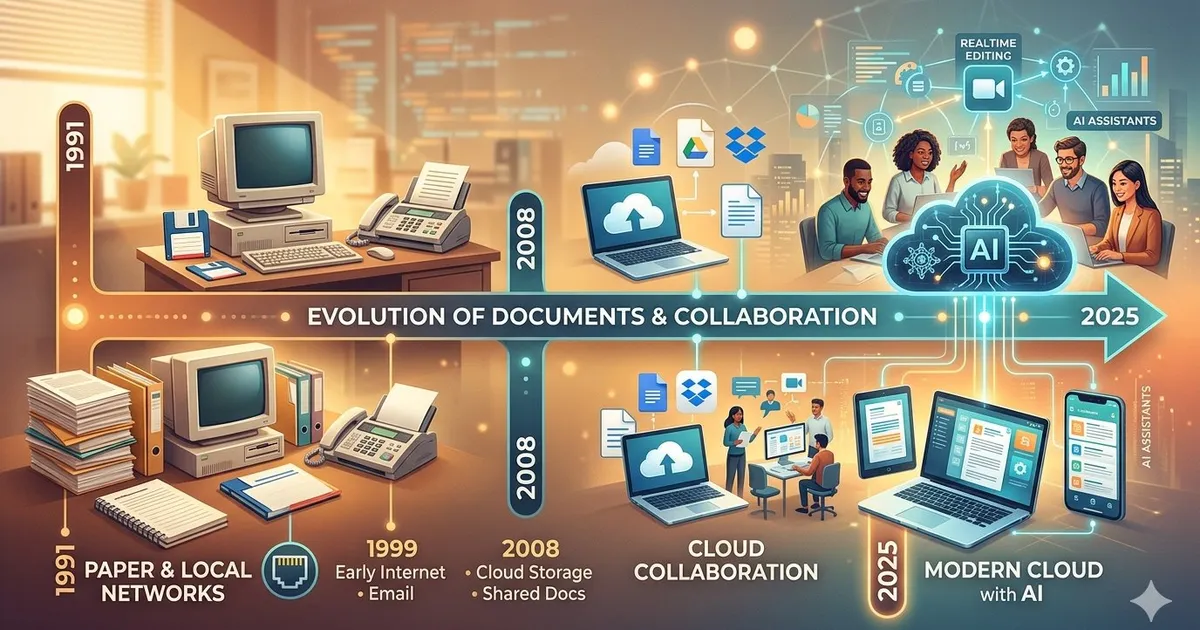
The beginning: when documents lived on local networks
In 1991, I founded Eikon Tecnologia in São Paulo, Brazil. For the first seven years, we distributed and implemented imported document management software for large enterprises — companies like Petrobras and Volkswagen. Back then, there was no internet access. Everything ran on client-server architectures over local networks. If you wanted to see a document, you had to be physically connected to the right machine.
In 1998, our American supplier left the Brazilian market. We had a choice: find another vendor or build our own product. We chose to build.
That's when Eikon Documents was born — a genuinely Brazilian document management system, and a pioneer in web-based access. The early web was a harsh environment for document management. HTML and CSS were rudimentary. Browsers were unreliable. But we saw where things were headed, and we bet on the web.
It paid off. Over the following years, Eikon Documents was adopted by some of the largest infrastructure projects in Brazil:
- GASENE — a 1,370 km natural gas pipeline connecting Southeast to Northeast Brazil
- Belo Monte — the second largest hydroelectric plant in the country
- São Paulo Metro Line 17-Gold — an automated monorail system
- São Paulo ethanol pipeline network — strategic renewable energy infrastructure
Billions of dollars in infrastructure. Hundreds of thousands of documents. Decades of learning about what makes teams collaborate effectively.
The opportunity I could see but couldn't reach
Throughout those years, I kept seeing the same collaboration challenges in completely different contexts. A doctor coordinating a patient's treatment across multiple specialists. A lawyer managing due diligence with dozens of stakeholders. A professor organizing research with students and co-authors. An architect running a small renovation project.
They all needed what we had built for billion-dollar infrastructure projects — but adapted for their reality.
The problem was twofold. First, developing software was expensive. Adapting a complex system designed for heavy infrastructure to simpler use cases was not viable. Second, the industry's commercial model — per-user licensing — meant that the more people needed to collaborate, the more expensive it became. This was, in the end, how companies tried to recover their massive development investments.
So the opportunity sat there, visible but unreachable. For years.
The pandemic, Elixir, and a new beginning
During the pandemic, I discovered Elixir and the Phoenix framework. I studied it deeply and started building prototypes — first a new version of Eikon Documents, still following the original concepts, and then a complete management system for my wife's medical practice and senior fitness academy. She is a physician and professor at the University of São Paulo.
The more I built with Elixir, the more confident I became. The BEAM virtual machine — Elixir's runtime — handles massive concurrency naturally. It was designed for telecom systems that can never go down. For a document collaboration platform serving many users simultaneously, it's ideal.
This confidence led me to attempt what had been impossible before: building a modern, accessible platform with a tiny team. Sutram was developed by two of us — me, working without salary, and Claude, Anthropic's AI assistant, with a small fixed monthly subscription. That's it.
From first commit to version 1.0: six months.
Decades of domain expertise compressed into six months of development. That's what happens when deep experience meets the right technology and a capable AI partner.
And here's where technology comes full circle: Elixir is the programming language that performs best with Large Language Models. The same concurrency model that makes it perfect for real-time collaboration also makes it perfect for streaming AI responses.
How technology evolved — and why it matters now
Reflecting on 34 years, the technological evolution is staggering:
1991-1998 (Imported software era): Client-server on local networks. No internet. Documents locked inside company walls.
1998-2020 (Eikon Documents era): Pioneer in web-based document management. But early web was limited — rudimentary HTML, inconsistent CSS, browsers that could barely render a table correctly.
2025+ (Sutram era): Browsers now follow high-quality technical standards. We can build a Progressive Web App (PWA) that works beautifully on any device — phone, tablet, desktop — without writing separate applications for iOS, Android, or Windows. One codebase, every platform.
But the most important technological shift is something most people haven't heard of yet: the Model Context Protocol (MCP).
Why MCP changes everything
Having a good platform is necessary but not sufficient. You also need viable ways to load your content into it.
My own experience with medical exams made this painfully clear.
Over the past six years, I accumulated dozens of medical exam reports — ultrasounds, echocardiograms, Doppler studies, lab work. Each report was trapped in a different hospital or laboratory portal, behind a different login, in a different format.
In the past, I could have tried to organize these using Eikon Documents, or even Google Drive. But who would have the time and patience to visit each portal, download every report and image, and then re-upload them into a document management system? Nobody. That's why medical records remain scattered for most people.
With Sutram's MCP Server, Claude did it in a few hours.
The AI accessed the portals, downloaded the reports, organized them into structured folders by exam type and date inside my Sutram project, and created File Links — symbolic references that let me see the evolution of each exam over time without duplicating files.
This is the real breakthrough. MCP turns AI assistants into active participants in your content workflow. They can create folders, upload files, manage metadata, add comments, check out documents for editing, and publish new versions — all through a structured protocol, with proper access control.
It's not just about storing documents. It's about making them accessible to both humans and AI.
What Sutram is today
Sutram is a structured content platform built on 34 years of project management expertise. It works in six languages. It has a REST API and an MCP Server for AI integration. It supports versioned document workflows with check-out/check-in. It has real-time chat, document commenting anchored to specific positions in PDFs and images, and a built-in Markdown editor.
And it doesn't charge per user.
Sutram's pricing is based on resources — storage and bandwidth — not on how many people you invite. The BEAM/Elixir stack delivers exceptional performance per dollar, requiring significantly less hardware than conventional platforms. This means we can offer plans at prices that would have been impossible with traditional technology and licensing models.
Invite your entire team. Invite your clients. Invite your doctors. The price doesn't change.
The circle closes
In 1991, I started with document management for engineers who needed to collaborate on billion-dollar projects.
In 2025, I'm offering the same expertise — simplified, modernized, and accessible — to anyone who has people, files, and a goal.
The doctor tracking a patient's treatment across specialists. The architect managing a renovation. The researcher coordinating a thesis. The entrepreneur running due diligence.
They all deserve tools that were previously reserved for billion-dollar projects.
That's why I built Sutram.
Sutram is available now at sutram.io. The Basic plan is free.
If you work with AI tools like Claude, Cursor, or Claude Desktop, try the Sutram MCP Server — it's included in every plan from Pro onwards.